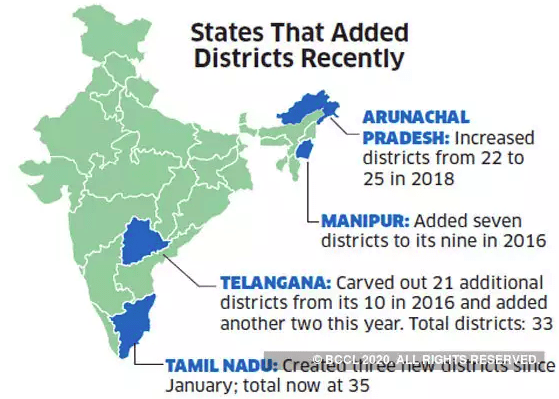
Every decade there is a significant increase in new districts for better governance. In just 8 months, 5 new districts were created in Tamil Nadu.[2]
With 10 states, including Maharashtra, Uttar Pradesh, and Rajasthan, having a higher average population per district than the country, the trend of breaking up districts is likely to continue. And though the district officials may be able to do a better job of governing a smaller unit, the formation of new districts would be better served by local bodies with more powers.
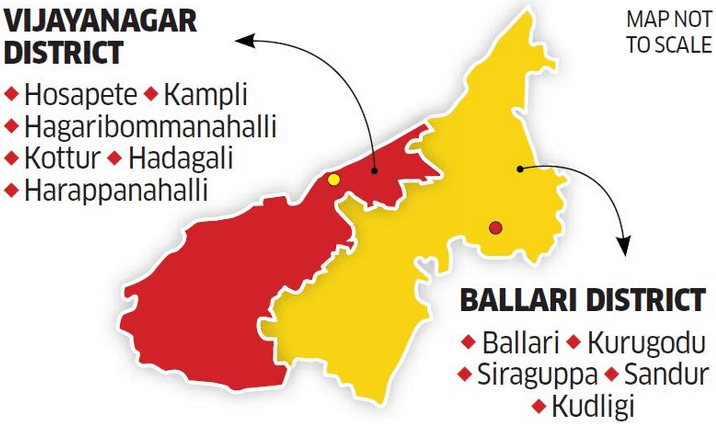
Some advantages and disadvantages for Bifurcation of Ballari.
Advantages:
- Population: The National average population per district is 18.6 Lakhs [1] and Ballari is 28.34 [3] Lakhs. The projection of the population for 2021 is 34.89 Lakhs [3]. A taluk office that caters to the needs of 1,000 people will struggle to reach out to them if their population increases to, say, 5,000. The people will not get the benefits of the welfare schemes in time. Refer to figure 2.
- Area: National Average area per district is 4950 km2 and the Ballari district’s area is 9893 km2[4]. If the area of administration is vast, it will cause delays in implementing welfare schemes and projects. Refer to figure 3.
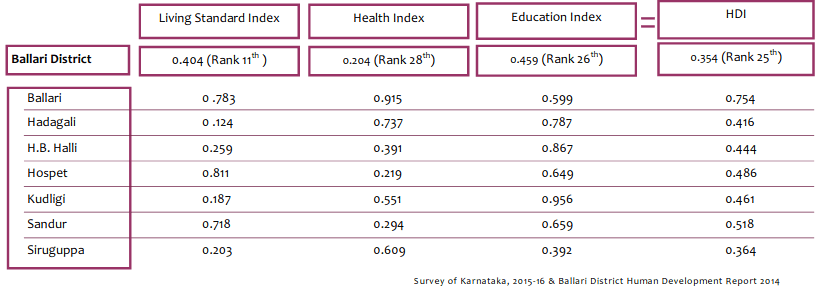
- Human Development Index: Compared to other taluks, Ballari tops in each and every Index, and other taluks are lagging behind according to Azim Premji Foundation’s report.[5] Refer to figure 3.
- Backward Regions Grant Fund (BRGF): Ballari doesn’t even come in Centre’s Backward region, so not applicable for BRGF. There is no questioning of the additional funds being received from the Centre.[10]
- Cost: For new Collectorate buildings, ranging from ₹110-₹115 crores will cost for the state’s exchequer. [6]. Anyhow we do spend 78 [7]crores on a statue. So spending money for the betterment of 28 lakh people would be the right option. That would empower Nation.
- Governance: The purpose of the delimitation of districts is ensuring that the people have easy access to the administration and enjoy the benefits of government schemes. It will make government programs reachable to the public. [8]
- Distance to District Headquarters(HQ): District HQ is located far east point. The distance between Mylara (Hadagali Taluk) to Ballari is 170 Kms. By car, it would take 4 hours to reach. The public bus might take a longer time to reach.[9]
- Institutes: Education institutes like JNVs will be built by the Centre. Siruguppa and Kurugodu people might still suffer to travel to JNV, if Kudligi is included in Ballari District.

Disadvantages:
- Pride in losing the some of the taluks. Hampi will be part of new district.
- New Collector and SP will be appointed for the new District and their residences.
My opinion:
People in Ballari (especially the east region) are opposing the idea of bifurcation. Recently a bandh was called. The pride of losing many taluks (and losing Hampi!) is distressing.
There is a significant water shortage in Ballari for 25 years (we get drinking water for 15 days once in Summer!). But I haven’t seen a single protest regarding water shortage. We should probably set our priorities right. The people have to decide what and how they want the government to run. For larger benefit, bifurcation is a must and it will eventually happen in the near future. Bifurcation will help our own people in this region to develop and to get new opportunities. People of Ballari should understand that pride is more important than problems that are facing by the west region of Ballari. The development will take as soon as the bifurcation takes place and people of the east region should allow it to happen.
Excerpts from Economic times on Bifurcation of Districts [1]:
Abhijit Bangar, Nagpur municipal commissioner, thinks it is the former. He was the first collector of Palghar district, near Mumbai, in 2014, after it was split from Thane, then India’s most populous district. He was there for nearly three years. He realised the problems of a large district when he was transferred to Amravati, a district 650 km east and more than twice the size of Palghar. “I felt I wouldn’t be able to do justice to Amravati,” he recalls. The farthest taluka in Amravati is around 150 km from the district headquarters, while in Palghar the distance is just half.
According to EAS Sarma, a former bureaucrat in the Union government, smaller districts bring administration closer to the people but only if “parallel steps are taken to enhance transparency in the functioning of the public offices”.
Others think the size of a district is not a big factor in governance as it is often made out to be. “Size is not as important as the mindset of officials. The district administration is accountable to the higher-ups, not to the people,” says G Bhaskara Rao, a former Unicef consultant to Telangana’s planning department.
Since the bodies below the district administration like the zilla parishad and the panchayat samiti do not enjoy a lot of powers, people take most of their grievances to the collector, for which they often have to travel for hours. Jayaprakash Narayan, a former civil servant and ex-MLA from Andhra Pradesh, says creating smaller districts without empowering these bodies is just a “substitute for genuine decentralisation”.
There are other benefits to adding new districts than ease of governance, says T Harish Rao, a former minister in the Telangana government. “Growth centres are created in new district headquarters and land rates go up.” He adds that new districts also benefit from district-specific central government initiatives. For instance, the government sets up an agricultural research and assistance centre and a residential school for gifted children in every district.
It Ain’t Easy Regardless of the benefits that accrue to a new district, the very process of creating one can be challenging, says Bangar about his Palghar experience. “We had to find office space for 59 different departments and fill many positions. The collector’s office alone had 200 people. “He had to go through 30,000 applications to appoint 150 clerks. “You are a new district for six months. After that the government expects performance on par with other districts,” adds Bangar.
Narayan, who was part of the 2nd Administrative Reforms Commission in the 2000s, calls the political gains from new district a “minor dividend”. “In the short term, it’s a popular move since everyone wants a district headquarters.” He adds that the collectors of new districts he spoke to in Telangana are glad that they can now devote a lot more time to their districts’ issues. “I didn’t anticipate that.”
References:
- EconomicTimes https://economictimes.indiatimes.com/news/politics-and-nation/do-indias-newly-added-districts-yield-desired-governance-results/articleshow/70516246.cms?from=mdr
- Indian Express https://indianexpress.com/article/explained/explained-why-tamil-nadu-is-in-a-rush-to-create-new-districts-32-to-35-districts-5840260/
- Directorate of Economics and Statistics, Bengaluru https://des.kar.nic.in/docs/Projected%20Population%202012-2021.pdf
- Central Ground Water Board, Government of India http://cgwb.gov.in/AQM/NAQUIM_REPORT/karnataka/harapanahalli.pdf
- Azim Premji Foundation http://apfstatic.s3.ap-south-1.amazonaws.com/s3fs-public/Karnataka_Ballari.pdf?2vBEn0DkR66tKF3jyhz48Iu1YjFGg6dq
- The Hindu https://www.thehindu.com/news/national/tamil-nadu/work-on-collectorates-in-four-new-tamil-nadu-districts-to-begin-soon/article31584139.ece
- Times of India https://timesofindia.indiatimes.com/city/bengaluru/govt-to-bear-cost-of-rs-78-crore-nadaprabhu-kempegowda-statue-karnataka-deputy-cm-ashwath-narayan/articleshow/76654709.cms
- The Hindu https://www.thehindu.com/news/national/tamil-nadu/work-on-collectorates-in-four-new-tamil-nadu-districts-to-begin-soon/article31584139.ece
- Google Maps https://goo.gl/maps/vCASX3rkND6Fg4gX7
- Ministry of Panchayat Raj https://data.gov.in/resources/list-272-backward-regions-grant-fund-brgf-districts-2015-ministry-panchayati-raj
- Deccan Herald https://www.deccanherald.com/state/vijayanagar-to-be-31st-district-in-karnataka-762662.html
 Why so simple?